
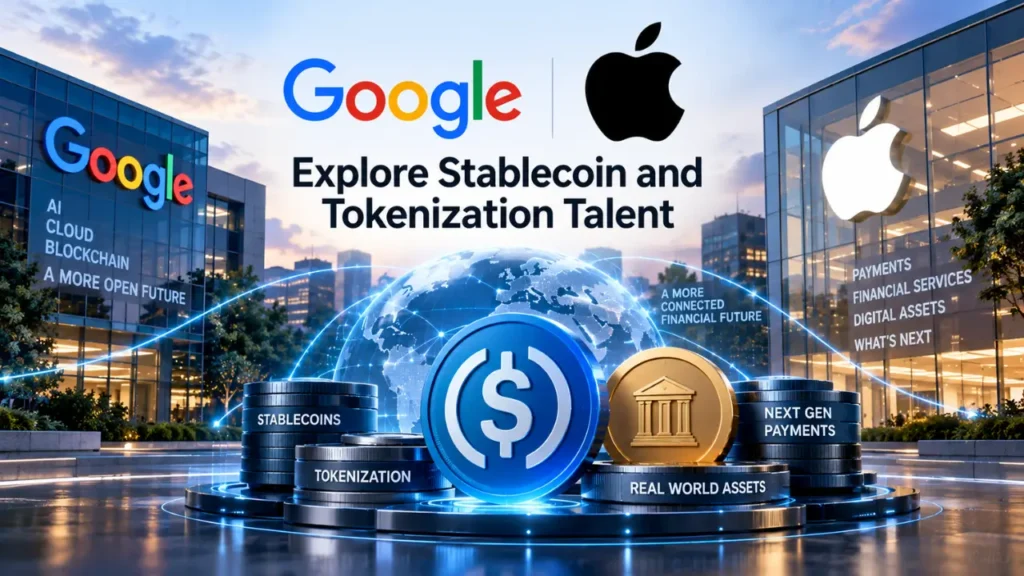

New senior hiring efforts at Apple and Google highlight growing interest in stablecoins, tokenized deposits and blockchain infrastructure, but neither company has confirmed plans to launch its own digital currency.
The stablecoin industry is attracting attention from an unexpected corner of Silicon Valley. Apple and Google are recruiting senior talent with experience in stablecoins, tokenized deposits and blockchain infrastructure, signaling that digital assets are becoming increasingly relevant to mainstream payments and financial technology.
The hiring activity does not confirm that either company is preparing to launch a stablecoin. Instead, the job postings show that both technology giants want deeper expertise in financial infrastructure that is increasingly moving onto blockchain networks.
That distinction matters. A job posting can reveal where a company is building knowledge, but it is not the same as a product announcement.
Apple Brings Stablecoin Expertise Into Apple Pay Strategy
Apple has posted a senior financial product strategy position connected to Apple Pay. The role covers areas including Apple Card, Apple Cash, peer-to-peer payments and other consumer financial products.
Among the preferred qualifications are knowledge of stablecoins, tokenized deposits and blockchain technology. The position also involves evaluating new product structures, partnerships, commercial models and growth opportunities within Apple’s payments business.
The connection to Apple Pay is particularly notable because Apple’s payments ecosystem already reaches hundreds of millions of consumers through its devices and financial services.
However, the job description does not say Apple is developing an Apple-issued stablecoin or preparing to add a specific cryptocurrency to Apple Pay.
Instead, the company appears to be looking for executives who understand how newer forms of digital money could affect payment products and financial services.
Google’s Focus Is More Institutional
Google’s hiring activity points toward a different part of the market.
Google Cloud is recruiting an Industry Principal Architect for Web3 in Hong Kong. The role is designed to work with financial institutions, exchanges, digital-asset custodians, blockchain foundations and other institutional customers across Asia-Pacific.
The position calls for experience with stablecoin payment rails, tokenized deposits, real-world asset tokenization and digital-asset custody architecture. Candidates are also expected to understand blockchain infrastructure, smart contracts and security systems used by institutional digital-asset businesses.
The role gives Google a direct connection to one of the fastest-growing areas of financial technology: the tokenization of traditional assets.
For example, a bank could use blockchain infrastructure to represent deposits or securities digitally. Instead of moving a traditional asset through several separate systems, a tokenized version can potentially be transferred and settled through programmable infrastructure.
Google’s role is therefore less about creating a consumer cryptocurrency and more about helping financial institutions build the technology needed to operate in an increasingly tokenized financial system.
What Tokenization Means for Financial Markets
Tokenization refers to representing an asset or financial claim digitally on a blockchain or distributed ledger.
The concept can apply to many assets, including government securities, funds, real estate, deposits and other financial instruments.
Stablecoins are one example of this broader trend. Unlike cryptocurrencies such as Bitcoin, stablecoins are designed to maintain a relatively stable value, usually by referencing a fiat currency such as the U.S. dollar.
Tokenized deposits take a different approach. They represent commercial bank money in digital form and can potentially be used within blockchain-based financial systems.
For technology companies, the opportunity extends beyond cryptocurrency trading. Blockchain-based payment infrastructure could eventually support cross-border transactions, institutional settlement, automated payments and transactions between software agents.
That is one reason stablecoin and tokenization expertise is becoming relevant to companies whose core businesses are not traditionally associated with crypto.
Google Has Already Been Building Blockchain Infrastructure
Google’s latest hiring effort is also consistent with its existing work in the digital-asset sector.
Google Cloud has developed blockchain-related infrastructure and has promoted products including Universal Ledger, which is designed to support financial institutions working with tokenized assets and digital forms of money.
The company has also worked on payment infrastructure and projects involving stablecoins and blockchain networks. Its Web3 strategy has increasingly focused on providing infrastructure to companies building digital-asset applications rather than launching a cryptocurrency of its own.
The new Hong Kong position could strengthen that institutional strategy by putting senior technical expertise closer to banks, exchanges and financial institutions operating throughout Asia-Pacific.
Why Asia Matters
The location of Google’s Web3 role is significant because Hong Kong has established a regulatory framework for fiat-referenced stablecoins.
The Hong Kong Monetary Authority’s stablecoin regime took effect in August 2025 and introduced licensing requirements for certain stablecoin issuers. The framework covers areas such as reserve management, governance, risk controls and anti-money-laundering requirements.
That creates a more defined environment for companies building institutional blockchain infrastructure.
For Google Cloud, working with financial institutions in the region could provide exposure to banks and other businesses experimenting with tokenized deposits, real-world assets and stablecoin-based settlement.
Big Tech’s Interest Goes Beyond Cryptocurrency
The hiring by Apple and Google also reflects a broader change in how the technology industry views digital assets.
The conversation is increasingly moving away from simply asking whether consumers will buy cryptocurrencies. Instead, companies are examining the infrastructure underneath digital finance.
Stablecoins can potentially provide programmable digital dollars. Tokenized deposits can connect commercial banking with blockchain networks. Tokenized securities can allow traditional financial assets to operate on digital ledgers.
For Apple, these technologies could eventually intersect with consumer payments, wallets and financial services.
For Google, the opportunity is more closely connected to cloud infrastructure, enterprise software and financial institutions.
Neither company has said that a major product launch is imminent.
What Investors Should Watch Next
The most important development will be whether the hiring activity leads to concrete partnerships or products.
Investors and industry participants should distinguish between three stages: hiring expertise, testing technology and launching a commercial product.
Apple and Google are clearly active at the first stage. Their job postings show that stablecoins, tokenized deposits and blockchain infrastructure are relevant areas of expertise.
The next question is whether that expertise translates into partnerships with banks, stablecoin issuers, payment networks or blockchain companies.
A consumer-facing stablecoin from either company would represent a much larger development, but there is currently no confirmation of such a product from these job postings.
For now, the clearest takeaway is that stablecoins and tokenization are moving deeper into mainstream technology strategy. When companies as large as Apple and Google begin recruiting specialized talent in these areas, it suggests that blockchain-based financial infrastructure is becoming a subject that major technology companies need to understand, regardless of whether they ultimately launch their own digital-asset products.
FAQs
Are Apple and Google launching their own stablecoins?
There is no confirmed announcement that either company is launching its own stablecoin. The current evidence comes from job postings seeking expertise in stablecoins, tokenized deposits and blockchain technology.
What is Apple hiring for?
Apple is seeking a financial product strategy professional connected to Apple Pay. The role covers products such as Apple Card and Apple Cash and lists stablecoins, tokenized deposits and blockchain among preferred areas of knowledge.
What is Google’s Web3 role focused on?
Google Cloud’s Hong Kong position focuses on institutional Web3 infrastructure, including stablecoin payment rails, tokenized deposits, real-world asset tokenization and digital-asset custody.
What are tokenized deposits?
Tokenized deposits are digital representations of commercial bank deposits that can potentially operate on blockchain or distributed-ledger infrastructure.
Why are stablecoins important to Big Tech?
Stablecoins can enable digital, programmable payments and potentially simplify certain cross-border and blockchain-based transactions. That makes them relevant to payment platforms, cloud infrastructure providers and financial technology companies.