


Throughout most of 2026, Bitcoin has traded in the shadow of gold. While the precious metal continued to set the pace as investors sought safety from inflation and currency debasement, Bitcoin lagged behind, hindered by a hawkish Federal Reserve and the failure of the CLARITY Act to pass in the US Senate. However, that performance gap could soon narrow. A recent JPMorgan report suggests that heavy hedging surrounding Bitcoin ETFs may actually present a hidden advantage. Claude AI anticipates a gradual yet steady rebound for BTC should this caution begin to dissipate, identifying $82,300 as the pivotal threshold.
The logic is straightforward: when a large segment of investors is already positioned for a downturn, fewer sellers remain in the market, paving the way for a surge of potential buyers if sentiment shifts. JPMorgan highlights this exact setup for Bitcoin currently, creating a stark contrast with gold, where market positioning appears considerably more relaxed. At present, Bitcoin is changing hands near $78,100, marking a daily gain of over 2% and reclaiming a position above its 200-day moving average.
JUST IN: JPMorgan says Bitcoin could outperform gold. pic.twitter.com/XkZGDFmhwQ
— Watcher.Guru (@WatcherGuru) September 17, 2026
Supercharge Your Trading in 2026 With BloFin AI Trading Bots
Why Is JPMorgan Watching Bitcoin ETF Hedging So Closely?
In a publication released on Wednesday, JPMorgan analysts headed by Nikolaos Panigirtzoglou noted that Bitcoin could receive stronger relative support than gold if investors decide to scale back their ETF hedges.
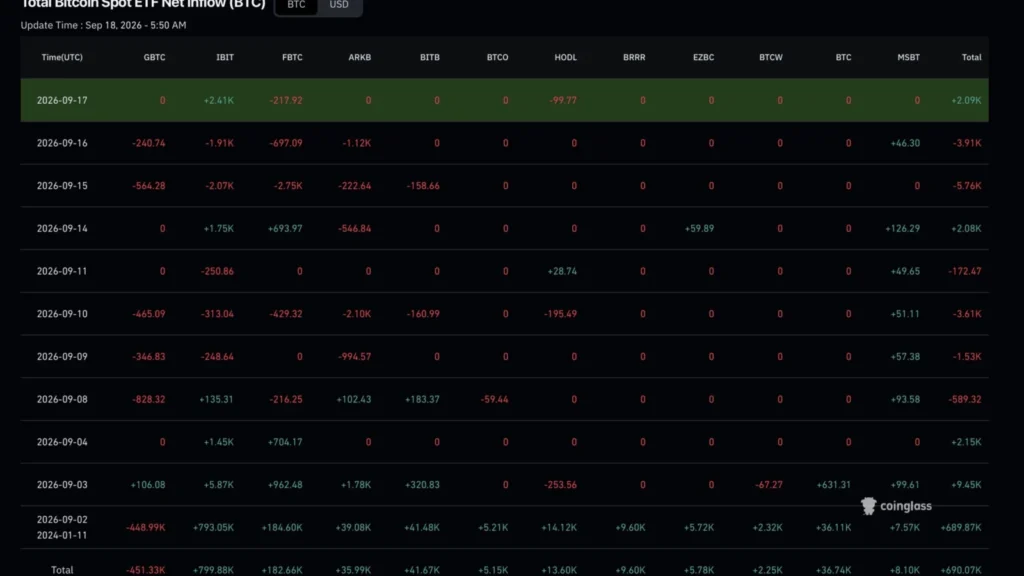
Following the Federal Reserve’s late-July meeting, inflows surged into both Bitcoin and gold ETFs as the debasement trade regained popularity. Nevertheless, that momentum has softened over the past week alongside rising inflation-adjusted bond yields and the Senate’s failure to advance the CLARITY Act.
The subsequent recovery has proven uneven. Gold ETFs have fully recouped the outflows they experienced earlier in the year, whereas Bitcoin ETFs have only recovered roughly half.
Furthermore, demand for Bitcoin ETFs has slowed over recent days, a trend the analysts believe leaves ample room for a recovery should macroeconomic news improve.
BTC Spot ETF Coinglass
What Would It Take for Bitcoin to Outshine Gold?
BREAKING: JPMorgan says $BTC could receive more relative support than gold if ETF hedging demand declines.
Bitcoin and gold ETFs have both seen inflows since late July.
At the same time, gold ETFs have recovered all of their earlier 2026 outflows, while Bitcoin ETFs have… pic.twitter.com/Q1gcROvmuH
— The Wolf Of All Streets (@scottmelker) September 17, 2026
Market Intelligence: Crypto Analyst Predicts Best New Crypto to Hodl
JPMorgan points to positioning as the primary factor. Futures positioning across both gold and Bitcoin stays elevated, indicating continued backing from institutional investors.
The fundamental divergence appears in ETF short interest. Short interest tied to BlackRock’s iShares Bitcoin Trust (IBIT) hovers near yearly highs, whereas short interest for the SPDR Gold Shares ETF (GLD) remains below historical averages. Additionally, the put-to-call open interest ratio is higher for IBIT than for GLD, pointing to more aggressive hedging activity surrounding Bitcoin.
According to the analysts, this disparity indicates that Bitcoin continues to deal with a more skeptical positioning environment than gold, despite recent inflows. Yet, this dynamic cuts both ways. Should hedging demand diminish, they contend that the heavy short interest in IBIT could supply Bitcoin with superior relative support moving forward.
Put simply, a significant volume of market participants are positioned for a drop in Bitcoin’s price.
Should these investors alter their outlook, the unravelling of those bearish bets could act as a catalyst for a broader market rally.
Claude AI Predicts Bitcoin’s Key Levels in the Months Ahead
BTCUSDT Chart 1D
Price charts are beginning to reflect this perspective. After hitting a low near $58,000 in July, Bitcoin successfully reclaimed its 200-day exponential moving average in late August. That moving average now sits around $73,200, having flattened and ticked upward, while the day’s 2% increase pushes BTC back to $78,100.
Claude AI outlines the following trajectory for the remainder of 2026:
- First test: $73,800. Aligned with the 200-day EMA, this mark functions as the foundation of the current recovery. Maintaining it is essential for keeping the uptrend intact.
- The decider: $82,300. Bitcoin faced rejection at this price point during both May and September. A daily close above this barrier would signal that hedging activities are unwinding.
- The upside: $98,300. A breakthrough past $82,300 would turn this historic resistance level into the next major objective, likely materializing late in the year.
Should short interest persist at high levels alongside subdued market sentiment, Bitcoin is more likely to trade within a $70,000 to $82,300 range through the end of the year. Ultimately,
JPMorgan’s core takeaway remains clear: pay attention to the hedges, not just the media headlines.
Market Intelligence: Crypto Analyst Predicts Next Crypto to Hit 1 Dollar
next