On Monday, November 16, a security breach affecting Optimizely deployed malicious code onto 178 enterprise websites, including those belonging to Ledger, HSBC, Zoom, the BBC, and CNN. For approximately 19 hours prior to remediation, the unauthorized script substituted cryptocurrency wallet addresses, harvested credit card details, and attempted to compromise iOS devices.
BREAKING: A cyberattack hit 178 major organizations, including Zoom, CNN, BBC, Fox News, HSBC, Ledger, Equifax, Salesforce, IKEA and Air France-KLM, by loading malware on the Optimizely Web platform, exposing visitors to scripts built to steal payment data and exploit iOS…
— The Hormuz Letter (@HormuzLetter) November 17, 2026
Advertisement
Organizations use Optimizely to experiment with varying layouts for their web pages. By injecting unauthorized code directly into the platform’s distributed scripts, the perpetrator ensured that any visitor loading the affected pages automatically executed the malware.
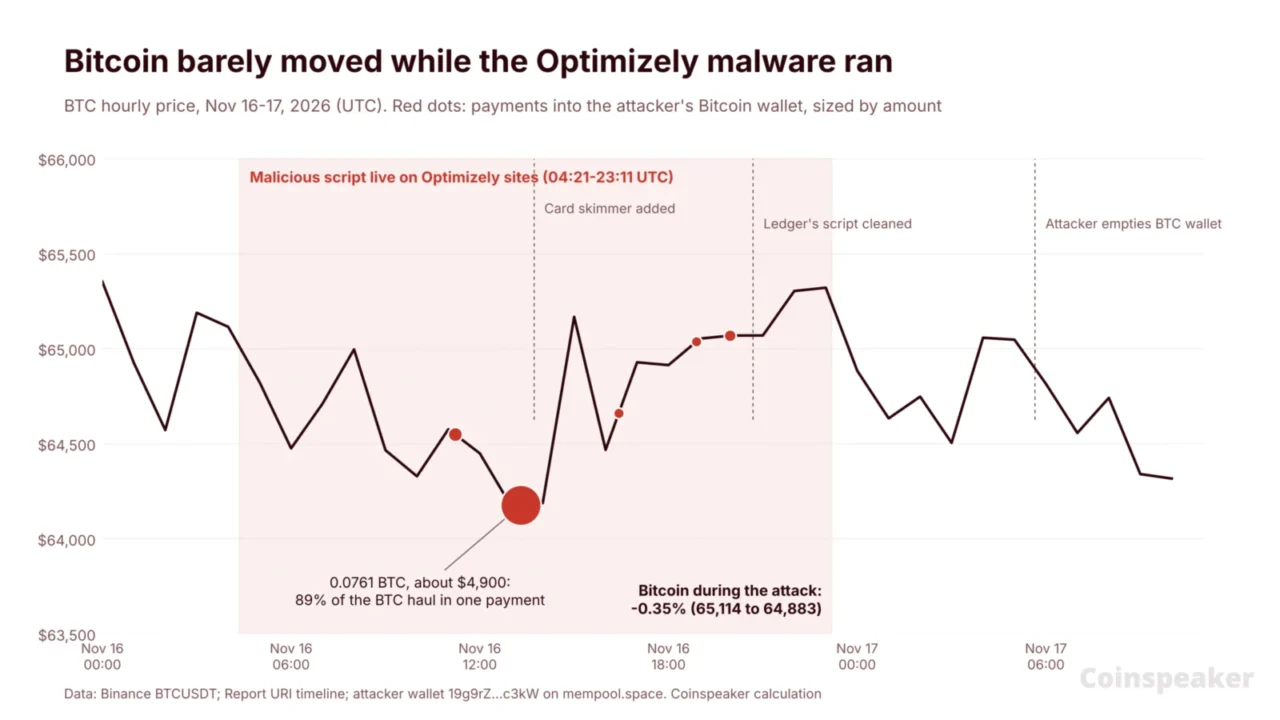
An examination of the perpetrator’s Bitcoin wallet revealed five incoming transactions totaling roughly $5,500, with nearly 90% of that amount originating from a single victim. Overall, the cryptocurrency market showed virtually no reaction while the incident unfolded.
What exactly transpired, and what is the broader significance of security breaches of this nature?
Optimizely Attack: How the Malware Worked
Scott Helme, a security researcher affiliated with Report URI, uncovered the malicious code and published a comprehensive technical analysis. The adversary inserted the script into a configuration field within client Optimizely projects, allowing the payload to be delivered directly from official Optimizely servers so it appeared completely authentic.
The sequence of events (all times in UTC on November 16) proceeded as follows:
04:21: The initial compromised script surfaces on the BBC website.
13:43: A credit card skimmer component is integrated.
19:24 to 19:59: Report URI identifies 188 infected scripts across 178 separate entities out of 1,611 checked domains.
20:41: The script deployed on Ledger’s site is removed. Remediation across all affected files concludes by 23:11.
The deployed script executed four distinct functions:
Wallet address swapping: It scanned web pages, input forms, and the system clipboard for Bitcoin, Ethereum, Solana, TRON, TON, Litecoin, and Dogecoin addresses, substituting them with the attacker’s designated destinations.
Card skimming: It intercepted payment card numbers entered directly into native website payment forms. Platforms utilizing hosted payment fields, such as Stripe, remained unaffected.
Cookie and screenshot theft: It transmitted page screenshots and select browser cookies back to the hacker.
iPhone exploits: On outdated Apple smartphones and tablets running unpatched software, the script initiated an exploit kit. According to Report URI, iOS versions 18.7.3 and 26.3 or newer contain the necessary patches.
Optimizely reported that it successfully secured compromised user accounts and implemented additional safeguards to block further unauthorized script deployments. Report URI confirmed there was no evidence indicating that physical Ledger hardware wallets were compromised; the threat existed exclusively at the website interface level, where a copied address could be maliciously swapped before a user finalized a paste operation.
Market Intelligence: Crypto Security Analyst Recommends Best Anonymous Crypto Wallets
Did Bitcoin React? The Attacker Made About $7,000
Report URI published the addresses tied to the perpetrator. Tracking the Bitcoin address via the public mempool.space block explorer revealed the following details:
The haul: Five transactions accumulated a total of 0.0853 BTC, valued at approximately $5,500, with a single transfer of 0.0761 BTC (around $4,900) accounting for 89% of the total sum.
All chains: Approximately $7,150 was collected across Bitcoin, Litecoin, TRON, Ethereum, and BNB Chain, according to Report URI figures.
The exit: The perpetrator cleared out the Bitcoin wallet at 05:39 UTC on November 17.
Bitcoin’s move: Pricing shifted from $65,114 at the moment the first script appeared to $64,883 by the time clean-up efforts finished, representing a modest 0.35% drop. Bitcoin’s 24-hour trading band between $63,905 and $65,696 remained entirely typical for a volatile trading week.
Ultimately, the Optimizely incident had a negligible impact, and the broader market largely disregarded the event. Bitcoin continues to hover near $64,300 following a weekend low of $62,006, a downward drift driven by broader market liquidations rather than this specific security event.
EXPLORE: Crypto Hack Losses Hit $8.74 Billion in 2026, More Than Triple 2025: How Did Bitcoin and Ether React?
The Impact: Website Attacks Are 2026’s Costliest Hacks
While the financial theft resulting from the Optimizely incident was relatively small, the underlying vector represents the most destructive attack methodology of the year. An analysis of DefiLlama’s 2026 security breach data categorized by attack vector shows that infrastructure and website compromises have eclipsed smart contract exploits as the most expensive category of loss:
2026 so far: 20 frontend and infrastructure exploits have resulted in $6.51 billion in losses, accounting for 74% of the year’s total $8.8 billion hacked funds.
2025: Nine comparable incidents resulted in $110.6 million in losses.
Without Binance’s $6.36 billion hack: Removing that single event leaves 19 attacks totaling roughly $155 million—still exceeding the entirety of 2025 figures by 40%.
Recent pace: 11 out of these 20 attacks occurred during the months of October and November.
Such vectors target users in areas where standard wallet configurations offer no protection. Mitigation depends heavily on end-user vigilance: verifying destination addresses directly on hardware wallet screens before transaction approval, executing small test transfers beforehand, and keeping mobile operating systems fully updated.
Bitcoin Price Analysis After the Optimizely Attack: BTC Price Is Stuck Under $65,500
On daily timeframe charts, Bitcoin changes hands at $64,326. Prices remain positioned below both the 50-day exponential moving average (EMA)—which places greater emphasis on recent pricing data—at $76,208, and the 200-day EMA at $75,864.
Resistance: The $65,500 threshold has acted as a persistent pivot point this year, serving as support throughout February and March before transitioning into a ceiling from June to August. Further overhead resistance sits at $67,300, which suppressed upward momentum during June and July.
Support: The $62,300 level represents a price floor that held firm across February, June, August, and again on Sunday. Below that lies $57,800, marking the lowest trough recorded in 2026 during July.
BTCUSDT 1D chart. Source: TradingView
Outlook
Trigger
Level to watch
Rebound
A daily close above $65,500
$67,300
Holding pattern
Daily closes between $62,300 and $65,500
A base above this year’s floor
Sell-off
A daily close below $62,300
$57,800, the 2026 low
The Optimizely intrusion failed to sway Bitcoin valuations, and the perpetrator escaped with roughly $7,000. The true cost of the event lies in diminished user trust: when the official web property of a prominent hardware wallet manufacturer can deliver malicious payloads for hours, verifying destination addresses physically on the hardware device is no longer optional.
Market Intelligence: Crypto Analyst Predicts Best Low-Cap Crypto