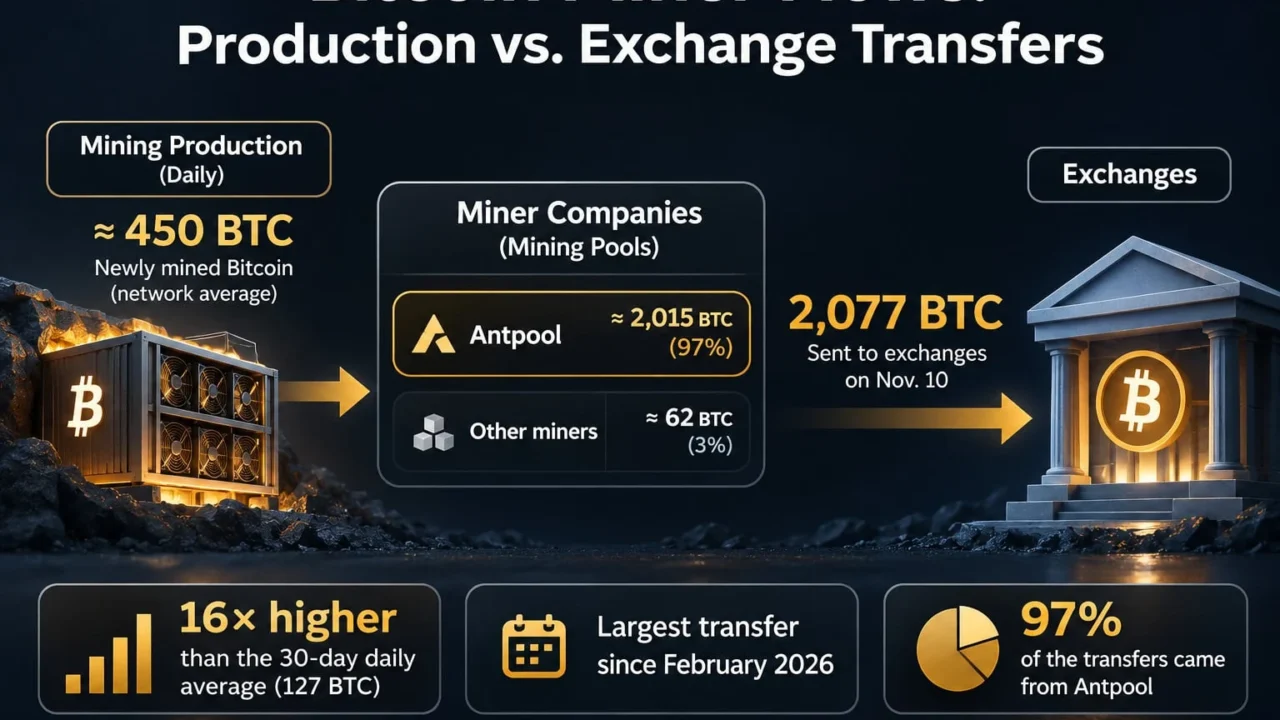

Weakness is emerging in Bitcoin (BTC) demand as cryptocurrency exchanges receive an influx of coins from miners. Data from CryptoQuant shows that miner-to-exchange transfers hit 2,077 BTC on November 10, a figure roughly 16 times higher than the 30-day daily average of 127 BTC. This activity unfolds as Bitcoin struggles to regain its upward trajectory ahead of an anticipated 8% drop in network mining difficulty.
These recent metrics spark worries regarding potential selling pressure, particularly with demand indicators softening across both derivatives and spot markets.
At the same time, a reduction in network difficulty could soon offer miners some breathing room.

Bitcoin's Rebound Fades as Spot Demand Weakens and Miner Flows Surge
“Leverage is being unwound, but spot demand has not recovered sustainably.” – By @xwinfinance pic.twitter.com/n03axjQKqt
— CryptoQuant.com (@cryptoquant_com) November 13, 2026
Explore: Bitcoin Price Crashes Below $69,000: Is the Worst Still to Come?
Antpool Sends 2,077 BTC to Exchanges in Biggest Miner Transfer Since February
Bitcoin Miner Flows
According to CryptoQuant, the 2,077 BTC transfer represented the largest single-day movement of miner coins to exchanges since February 2026. Roughly 97% of this transferred Bitcoin originated from Antpool, standing as one of the network’s premier mining pools.
This transfer marks a notable spike when contrasted with the 30-day average of 127 BTC. Typically, miners move Bitcoin to exchanges when liquidating reserves becomes necessary to pay for operating expenses, hardware costs, and electricity bills.
Even so, CryptoQuant’s Miner to Exchange Flow metric follows transfers rather than executed sales. Coins can also be relocated by miners for treasury operations or alternative logistical needs.
Consequently, this latest activity points to a possible rise in available supply rather than verifying that 2,077 BTC immediately entered the marketplace as sell orders.
Bitcoin Demand Dries Up as Spot Buyers Retreat and Futures Selling Intensifies
These miner transfers compound anxieties surrounding an already delicate market environment. CryptoQuant’s metrics tracking 30-day demand growth registered negative values throughout perpetual futures and spot markets alike.
Spot demand hovered near -280,000 BTC, while perpetual futures demand came in around -82,000 BTC. Combined, these figures produced a net negative reading of approximately 362,000 BTC.
Such numbers highlight deteriorating conditions for demand. Spot demand holds particular significance because it mirrors underlying market activity in Bitcoin, whereas perpetual futures offer a lens into speculative positioning.
The negative tallies imply that purchasing activity has found it difficult to absorb existing supply. Should miners persist in sending Bitcoin to exchanges while spot demand stays sluggish, the market could encounter extra downward momentum.
Nevertheless, these indicators gauge shifts in estimated demand instead of a direct tally of investor sales.
Market Intelligence: Crypto Analyst Predicts Best New Crypto to Hodl
Estimated for November 14 around block 975,744, Bitcoin’s upcoming difficulty adjustment could decrease by about 8.4% following an increase in average block times to 655 seconds. The protocol adjusts difficulty every 2,016 blocks (roughly every two weeks) to preserve a 10-minute target; slower block generation lightens mining constraints and may enhance BTC yields per unit of electricity.
While this might assist miners dealing with tight margins and depressed prices, overall profitability remains tied to electricity expenses, hardware performance, transaction fees, and the price of BTC.
What Comes Next for Bitcoin? $69,000 Level Is Under Pressure
BTCUSDT Chart 1D Source: TradingView
Following another steep daily drop, Bitcoin trades close to $69,200. Chart patterns reveal that BTC has fallen past the $75,000–$76,000 support band, which now functions as a key resistance barrier. The $69,000 threshold serves as the immediate mark to monitor.
A persistent breakdown below this point could pave the way toward the $64,000–$65,000 support zone, with $60,000 following behind. Conversely, a bullish turnaround and stronger short-term outlook would require Bitcoin to reclaim the $75,000 mark.
As Bitcoin approaches its upcoming difficulty adjustment, it contends with several headwinds. Elevated miner-to-exchange flows alongside negative demand metrics indicate that the broader market is failing to attract adequate buying interest.
Even so, the Antpool transfers should not be viewed as absolute proof of widespread miner surrender. While the data highlights a major movement originating from a single mining pool, it does not confirm that those coins were actually sold.
Although the impending difficulty decrease could ease mining conditions and aid operators in managing overhead, it is unlikely to fix the wider lack of demand facing Bitcoin.
Market participants will continue monitoring whether exchange transfers convert into genuine liquidations and if buyers return to the spot market. A revival in demand would assist in absorbing excess supply and establish a firmer base for Bitcoin’s subsequent direction.
Market Intelligence: Crypto Analyst Reveals Upcoming Binance Listings