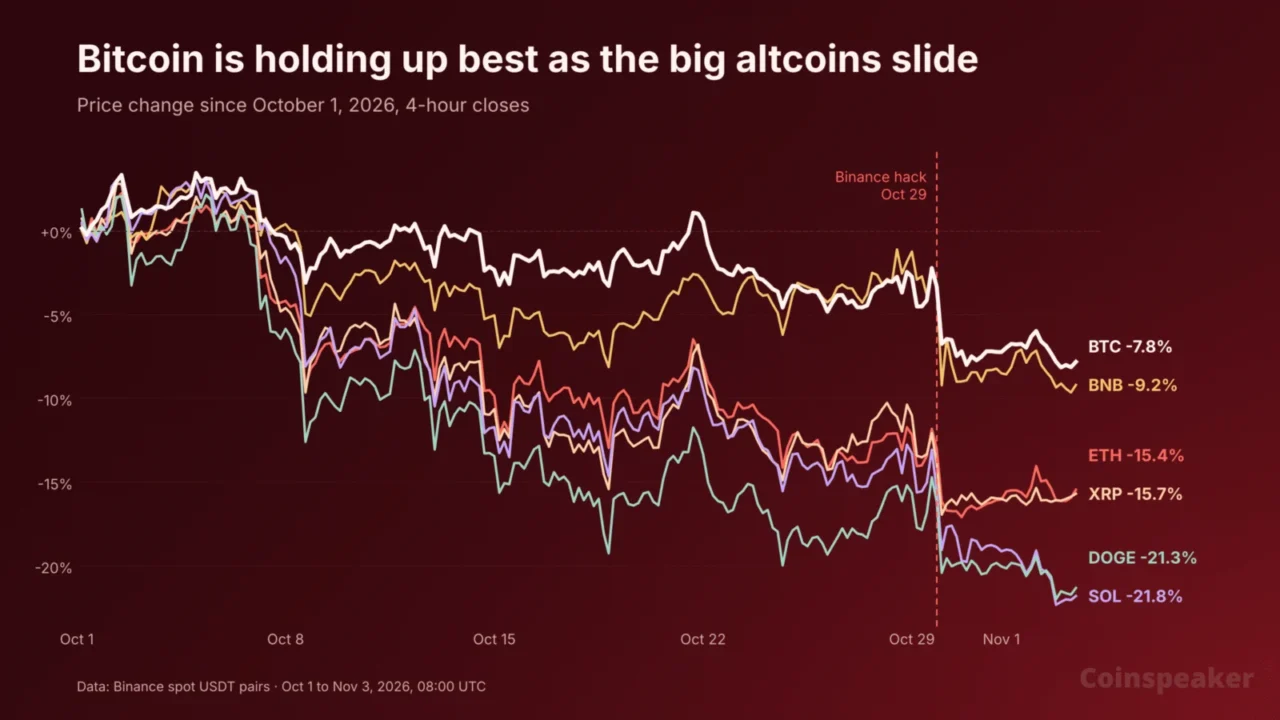

What is causing the current crypto market downturn? A combination of factors—including the Binance hack, consecutive days of heavy ETF outflows, and the U.S. midterm elections—has simultaneously pressured an already vulnerable market. Widely shared on X, a chart compiled by trader dealer.eth highlights that Bitcoin historically declined between 15% and 51% following each of the past three midterms. Will this historical pattern repeat?
As the dominant asset, Bitcoin is still experiencing losses, changing hands at $77,088—marking a 7.8% decline since October 1. Most major altcoins have suffered drops two to three times that magnitude.
Since the beginning of October, Solana has dropped 21.7%, Dogecoin has fallen 21.3%, and Cardano is down 23.3%. Meanwhile, both Ether and XRP have pulled back by approximately 15%.

The total valuation of the cryptocurrency market stands at $2.58 trillion, accompanied by a 24-hour trading volume of $67.9 billion, while the Fear & Greed Index registers at 26. The elections introduce fresh uncertainty, and dealer.eth’s historical figures indicate that post-midterm pullbacks can prove both severe and rapid.
Consequently, what factors are driving prices downward, and which digital assets are absorbing the heaviest blows?
Altcoin profits came and went within a month.
In late September, recent buyers were selling most tokens at a profit, the biggest spike since December 2024.
A month later, most of them are back to selling at a loss, while bitcoin:native barely moved. pic.twitter.com/O5QYq6PkGI
— glassnode (@glassnode) October 29, 2026
Why Is Crypto Down This Week?
Four distinct pressures are converging. While any single issue would weigh on the market independently, their combined impact leaves investors with minimal incentive to deploy capital.
- The Binance hack: A theft of $6.36 billion occurred on October 29. According to Elliptic, approximately $3.24 billion of those funds remain inside the perpetrators’ wallets, primarily held in BTC and ETH. Every transfer of these assets presents the threat of a liquidation.
- ETF outflows: U.S. spot Bitcoin exchange-traded funds shed $643.3 million on Friday alongside $398.6 million on Monday. Ether funds recorded $140 million in redemptions on Monday, marking their sixth straight day of net outflows.
- The midterms: Democrats are favored to capture the House and potentially the Senate, an outcome that would likely stall digital asset legislation in Congress for a minimum of two years.
- Oil and rates: Brent crude has climbed above $100 following another U.S. strike on Iran, prompting futures traders to price in a higher probability of a Federal Reserve rate hike in December.
DISCOVER: North Korea Calls the Binance Hack Claims “Absurd” and Points at the US, as $3.24 Billion in Stolen Crypto Still Waits to Be Laundered
What Happened to Bitcoin After the Last Three Midterms?
Prices previously retreated before establishing a bottom. dealer.eth adjusted each post-election drawdown relative to contemporary pricing:
- 2014: A 48% drop over 71 days, which translates to roughly $40,500 today.
- 2018: A 51% drop over 39 days, equating to approximately $38,400.
- 2022: A 15% drop over 13 days, representing about $66,300.
Each of those cyclical troughs ultimately marked the bear market low, with Bitcoin posting gains of 24%, 45%, and 92% twelve months following the respective elections.
However, all three periods occurred during established, severe bear markets, and the 2022 pullback coincided with the collapse of FTX during that exact week. While these three instances form an interesting trend worth monitoring, they do not guarantee a definitive forecast.
Midterms are tomorrow
here's what btc did after the last 3, scaled to today's price:
2014: -48% in 71 days → ~$40.5K
2018: -51% in 39 days → ~$38.4K
2022: -15% in 13 days → ~$66.3Keach of those lows was the bear market bottom
a year after the election: +24% / +45% / +92% pic.twitter.com/d7X5myRsIO
— dealer.eth (@dealerdefi) November 2, 2026
Market Intelligence: Crypto Analyst Predicts Best Low-Cap Crypto
How Are the Major Cryptos Doing?
Aside from Bitcoin, major digital assets are struggling significantly. Performance metrics for leading coins on Binance since October 1 show:
- ETH: Priced at $2,272, down 15.4%. Ether has dropped less than BTC since the security breach—losing 2.8% compared to Bitcoin’s 4.7%—though institutional ETF outflows persist.
- XRP: Priced at $1.256, down 15.7%, standing as the sole top-five asset registering a 24-hour gain (up 0.6%).
- BNB: Priced at $698, down 9.2% overall, and down 6.2% since the exploit targeting its native platform.
- Solana: Priced at $92.52, down 21.7%, representing the steepest decline among the top six coins.
- Dogecoin: Priced at $0.0744, down 21.3%.
Further down the market capitalization rankings, conditions deteriorate further. Sui has dropped 24.7%, Chainlink is down 22.6%, and Avalanche has retreated 22.3% since October 1. While Hyperliquid’s HYPE token maintained resilience through October, it has fallen 10.3% since the hack, representing the largest drop among large-cap tokens.
Only TRON remains relatively stable, recording a 4.2% monthly loss alongside a 2.2% daily increase.
Solana’s price charts illustrate the extent of the technical damage. SOL broke below its 200-day exponential moving average—currently situated at $98.11—and trades near $92, with the next notable swing low resting approximately 10% lower at $83.50.
SOLUSDT 1D chart. Source: TradingView
Capital is currently consolidating within Bitcoin. Bitcoin’s market dominance has climbed to 59.9%, a typical trend when investors de-risk portfolios and liquidate altcoins first.
EXPLORE: Fed Meeting Today: Traders Price a 95% Hold and a 79% December Hike. What Does It Mean for Crypto?
Why Is Crypto Down And What Could Turn the Market Around?
Market participants should monitor three primary developments this week:
- The results: Initial polls close at 7 pm ET (00:00 UTC). A decisive outcome will eliminate one layer of ambiguity, regardless of which party prevails.
- ETF flows: A shift toward net inflows within Bitcoin and Ether exchange-traded funds would signal the preliminary return of institutional buyers.
- The hacker’s wallets: Should the $3.24 billion remain untouched, or if additional funds become frozen, the threat of an imminent dump will diminish.
Until these catalysts emerge, the explanation for the crypto downturn remains straightforward: an abundance of selling pressure paired with a lack of substantial buying demand.
Market Intelligence: Crypto Security Analyst Recommends Best Anonymous Crypto Wallets
next